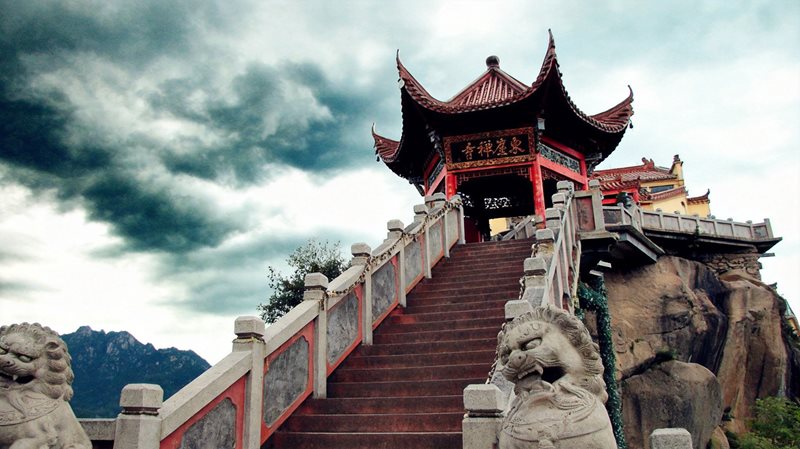
Jiuhua Mountain Scenic Area is located in Chizhou, Anhui. The natural scenery is unique, the peaks are beautiful, the mountains are undulating, the vegetation between the mountains is lush, and the scenery is different in all seasons. The Tiantai Peak is majestic and magnificent, and the Lotus Peak is shaped like a lotus bloom.
It has a rich historical and cultural heritage and is one of the four famous mountains of Buddhism in China. Since the Tang Dynasty, Buddhism has flourished here. Numerous ancient temples are scattered across the mountains, such as Huacheng Temple, which was built in the Eastern Jin Dynasty and is the ancestral temple of Jiuhua Mountain. The temple of the body is solemn and solemn, offering the body of the flawless monk. Many high-ranking monks and great virtues practice here, leaving countless legends and Buddhist cultural relics. Many Buddhist activities are held here, and incense is flourishing, attracting countless good men and women and tourists to experience the breadth and depth of Buddhist culture and the unique charm of natural beauty.
#Jiuhua Mountain 2026 latest tour guide (prayer + sightseeing full coverage)
Jiuhua Mountain is one of the four famous Buddhist mountains in China. The Jizang Bodhisattva dojo has both the Zen atmosphere of the thousand-year-old temple and the natural grandeur of the Yunhai Songtao. Combined with the latest policy and measured route in 2026, sort out this strategy of not detouring or stepping on pits, and the novice directly copies the homework 👇
📌 basic information (latest in August 2026)
Tickets & Transportation
- ** Core Scenic Area Grand Ticket **: The current season is 160 yuan/person (January 16-November 14), and the off-season (November 15-January 15 of the following year) is 140 yuan/person; the ticket is valid within 3 days and can be admitted for the second time (advance registration is required).
- Discount: seniors over 65 years old, children under 6 years old/children under 1.2 meters are free of charge; students and seniors aged 60-65 are half price and bring their documents.
- ** Scenic traffic **: You must buy a 50 yuan/person pass, and take the scenic shuttle bus unlimited times, covering all areas such as Jiuhua Street, Rooftop, Huatai, etc. There are many curves on the mountain road, so walking is not recommended.
- ** Ropeway/Cable Car Price **:
- Rooftop cableway round-trip 160 yuan/person (peak season), Centennial Palace ground cable car round-trip 100 yuan/person, Huatai cableway round-trip 160 yuan/person; there are discounts in off-season (minimum 120 yuan in the off-season in the winter of 2025).
- ** Self-driving policy **: From July 20, 2026, tourist vehicles can be reserved in advance (7 days in advance at the earliest) through the official channel of "Jiuhua Mountain Scenic Area" to enter the core scenic spot (Jiuhua Street), and the number of places is limited. Be sure to grab it in advance; unreserved vehicles need to stop at the Kecun Visitor Center at the foot of the mountain and transfer to the scenery to go up the mountain.
- ** External transportation **: High-speed rail to Chizhou Station, and take the scenic bus 50 yuan/person for about 1 hour to Jiuhua Street; tourists who fly to Jiuhua Mountain Airport can enjoy half price tickets with their boarding passes within 5 days (the event is subject to the official real-time notice).
###opening hours
- The core scenic spots are open all day, with temples generally from 6:00 to 17:30; the Dawan Cultural Park (99 meters of Jizang Icon) is open from 8:00 to 17:00, and the Saturday night tour is open until 19:00. Tickets start from 150 yuan (some channels can be booked for free visits, subject to the official).
---
##🗺️ days route recommendation (select on demand)
###✅ 2 days 1 night classic (prayer + core attractions, suitable for weekend tour)
** Suitable for the crowd **: Tourists who come to the mountain for the first time and are in a hurry, taking into account the worship of Buddha and the clock in
- ** Day1: First Entry to Buddha Country · Jiuhua Street Prayer **
- Morning: Arrive at the Kecun Visitor Center, and successfully drive directly to Jiuhua Street without making an appointment to sit on the mountain; after checking in, visit the ** Huacheng Temple ** (Jiuhua Mountain Kaishan Ancestral Temple, the release pool shoots the reflection of the ancient temple beyond the film), next to Jiuhua Mountain Historical Relics Museum is worth spending 1 hour to read the ancient inscriptions.
- Afternoon: Walk to the Three Great Treasures Hall of Danlin ** (Daxiong Hall, Great Wish Hall, Great Compassion Hall), then go to the Moon Body Hall ** (where the Bodhisattva Body Pagoda is located, climb 81 steps to pray for blessings, and the red wall is equipped with incense to shoot Zen blockbusters); physical strength can generally sit directly on the scene, and walk about 40 minutes.
- Evening: stroll around Jiuhua Old Street, eat vegetarian food at the temple, listen to the evening drum, and feel the Zen of fireworks in the evening.
- ** Day2: High Pilgrimage · Return **
- Morning: Take the Centenarian Palace cable car to the Centenarian Palace (dedicated to the body of the Flawless Zen Master, the temple is built in the sky by the mountain, and you can see the natural sleeping Buddha in the distance), and visit Dongya Zen Temple and Huixiang Pavilion on the way; then take the scenery to the rooftop scenic spot, take the rooftop cable road up the mountain, and walk for 1 hour to the top of the rooftop ** (Jiuhua core commanding heights, see the Yunhai Mountains, and the Yangtze River in good weather). Along the way, pass Guanyin Peak and the ancient worship platform.
- Noon: On the way down the mountain, visit the Minyuan Bamboo Sea to see the Millennium Phoenix Pine (the first pine in the world, with branches like phoenix wings).
- Afternoon: If you have enough time, you can go to the Yamashita Dawan Cultural Park to worship the 99-meter Jizang icon, and then return.
###✅ 3 days and 2 nights in-depth model (prayer + walking + panorama, suitable for self-driving/slow travel)
** Suitable for the crowd **: Blessing guests, hiking enthusiasts, families with children over 12 years old
- ** Day1 **: 1 night Day1 in the same 2 days, live on Jiuhua Street at night, you can ask the monastery in advance for the morning class time.
- ** Day2 **: In the morning, go to the Centennial Palace and Dongya Temple; in the afternoon, visit the rooftop scenic spot in depth, hike to the Ten Wangfeng (the highest peak of Jiuhua Mountain, 1342 meters above sea level), and return to Jiuhua Street in the evening to soak your feet and relax. You can buy plasters at the foot pharmacy to relieve soreness.
- ** Day3 **:
- Morning: Optional ① Go to Tianyuan Temple to participate in morning classes (no photos, keep quiet), or worship Migong Temple (the Temple of Wealth, seeking wealth and luck is very spiritual); ② Take the scenery and hand it over to ** Huatai Scenic Area ** (mainly natural scenery, no temples, suitable for viewing and taking pictures), take the cableway up the mountain to walk the cliff plank road, watch Dapeng listen to scriptures, Dinghai Shenzhen and other strange stones, there are alpine rhododendrons in spring, and rime in winter. The whole process is about 3 hours, and there are few people.
- Noon: Eat local dishes and buy souvenirs at Jiuhua Street or Yamashita New Street.
- Afternoon: Self-drive/take a scenic ride down the mountain, and visit Daiwan Cultural Park before returning.
---
##🍜 Food & Souvenirs
1. ** Must eat delicious food **
- Suzhai: The most authentic Suzhai in Gion Temple and Huacheng Temple, 30-50 yuan per capita, vegetarian chicken, vegetarian fish, and Kizang vegetarian noodles (20 yuan/bowl) are light and delicious, and they are very characteristic of vegetarian imitation meat.
- Local dishes: Yellow Essence Stewed Chicken (Yellow Essence is one of the three treasures of Jiuhua, nourishing and healthy, 80 yuan per capita), Lingyang Yipin Pot (authentic Hui cuisine, meat and vegetarian stacking and slow stewing, 60 yuan per capita), Shier scrambled eggs.
- Snack: Jiuhua vegetarian cake (15 yuan/serving, stuffed with yellow essence and mung beans, crispy and sweet, sold in small shops on the mountain).
2. ** Souvenir **: Jiuhua vegetarian cakes, yellow essence tea, and yellow essence fruit can be bought at regular stores on Jiuhua Street, and do not buy high-priced "enlightened" products on the roadside.
---
How to choose 🏨 accommodation
- ** Preferred Jiuhua Street (strong push) **: Core area, walk to major temples, eat and transfer are convenient, and you can listen to Zen sounds at night. Budget B & B 150-300 yuan/night, four-star hotel 400-800 yuan/night, many Zen B & B owners are laymen, and they will also send vegetarian cakes; book 1-3 days in advance in peak season.
- ** Near Kecun Visitor Center **: Cost-effective, homestay 100-200 yuan/night, convenient parking, suitable for tourists who drive by themselves but do not have an appointment to go up the mountain. The disadvantage is that it takes 40 minutes to go up the mountain, and it is troublesome to go back and forth in the morning and evening.
- ** Pit Avoidance **: Do not live on the top of the rooftop/Flower Terrace, the conditions are simple, and it is inconvenient to eat. It is only suitable for professional hikers.
---
##⚠️ Pit Avoidance & Practical Tips
1. ** Precautions for Buddhist worship **
- Do not step on the threshold when entering the door, men cross the left foot and women cross the right foot; you can use 3 sticks to serve incense, and you do not need to buy high-priced incense. There is generally free incense at the entrance of the temple.
- Do not take pictures of Buddha statues in the hall, keep quiet when participating in morning classes/dharma sessions, and do not touch the dharma tools at will.
- Prayer Times' own name and address, and then tell me your wish, which is more sincere.
2. ** Play pit avoidance **
- Don't believe that roadside tour guides "lead the way at a low price" and "free tickets" are all scams. Tickets are bought directly through official channels or regular platforms.
- Don't buy roadside "wild yellow spirit" and "enlightened Buddha statues", most of them are counterfeit, you need to go to a regular store.
- It's rainy in the mountains, bring a folding umbrella/raincoat no matter what season, it's slippery after a shower on the steps, wear non-slip sneakers, don't wear high heels or sandals.
3. ** Equipment recommendations **
- Bring a backpack, a thermos cup (temples can be connected to hot water), sunscreen, mosquito repellent, and carsickness medicine (there are many bends on the mountain road, and it is easy to take medicine in advance for carsickness); bring a thin coat in spring and autumn, the mountainous area is 5-8 ° C lower than the mountain, bring sunscreen clothes in summer, and wear thick cotton-padded clothes in winter.
4. ** Best time to visit **: Spring and autumn (March-May, September-November) have a comfortable climate and are suitable for hiking; winter (December-February) has rime clouds, tickets and accommodation are cheap, and there are few people. Summer (June-August) is a summer resort, but there are many showers, remember to bring rain gear.
If it is a day tourist with a particularly tight time, it is recommended to give priority to Jiuhua Street (Huacheng Temple + Moon Body Treasure Hall + Sandalwood Forest) + Rooftop Scenic Area, which can basically cover the humanities and natural essence of the core of Jiuhua Mountain~